




By Breelyn Vanleeuwen, PA-C | Founder & CEO of Daily Shade
I was a young PA on a surgical rotation at Brigham and Women's Hospital. One of the attending surgeons, someone I deeply respected, part of the Harvard medical team, was talking about post-procedure skin care with a patient. I remember him saying something like, "if you really want to protect your skin long-term, find a true mineral sunscreen you love and actually wear it every day. Not a hybrid. A TRUE mineral. It's the best thing you can do for your skin." I remember thinking I have no idea what a TRUE mineral meant, and I could tell most his patients didn't either. I filed this away.
Years later, when my daughter had a severe reaction to a sunscreen that had the word "baby" and "Mineral" on the label, that sentence came back to me. And I finally went looking for what he actually meant.
What is the difference between a Mineral and a TRUE Mineral Sunscreen?
What I found was frustrating.
(me as a PA student...)

96% of "mineral" sunscreens aren't actually really mineral sunscreen.
That's not an exaggeration. When I started researching, I learned that the vast majority of sunscreens marketed as mineral contain something called UV chemical boosters. These are ingredients that are structurally almost identical to chemical UV filters, think oxybenzone, avobenzone, octocrylene, but they aren't classified as active ingredients by the FDA. So brands can list zinc oxide as the only active on the label, call themselves 100% mineral, and still load the formula with boosters in the inactive ingredients section.
Most people never look at inactive ingredients. I didn't either, until I had to.
The boosters you'll most commonly find hiding in "mineral" sunscreens are butyloctyl salicylate (most common), ethylhexyl methoxyacrylate, diethylhexyl syringylidene malonate, tridecyl salicylate, and isododecane when used in a booster capacity. A few others that show up less frequently but are still worth knowing: polysilicone-15, drometrizole trisiloxane, and bemotrizinol.
These are not household names, and that's partly the point. Most parents have never heard of them, and most labels don't make them easy to find. They're buried in the inactive ingredients, written in chemical nomenclature that nobody outside a formulation lab would recognize on sight. But they are absorbing UV rays. They are contributing to the SPF number on the front of the bottle. And they are doing it without the safety track record that zinc oxide has spent decades building. These uv boosters make the formula feel thinner, spread more easily, test higher on SPF. They make a zinc sunscreen feel like a chemical sunscreen, which is kind of the whole point of adding them.
But they also mean the product isn't what it says it is.
Why this matters beyond the label
Boosters aren't tested under the same FDA protocols as active ingredients. We don't have the same safety data for them that we have for zinc oxide, which has decades of research behind it. Some of them act as penetration enhancers, meaning they can help other ingredients absorb deeper into skin layers. A few have shown photochemical reactions under sunlight, generating oxidative stress rather than protecting against it. And for kids with sensitive skin, or anyone who has had a reaction to a sunscreen they were told was safe? This is often why.
My daughter wasn't reacting to zinc. She was reacting to the chemistry hiding behind the zinc.
What TRUE Mineral actually means
When I finally understood what the surgeon at Brigham and Women's was pointing at all those years ago, it clicked. A true mineral sunscreen means zinc oxide, non-nano, without any uv chemical filters or boosters so it physically sits on top of the skin rather than absorbing into it. No uv chemical boosters inflating the SPF number. No UV chemical filters of any kind, active or inactive. No penetration enhancers that compromise the skin barrier.
Zinc oxide is the only single active ingredient that protects against UVA1, UVA2, and UVB. It's photostable, meaning it doesn't break down in sunlight. It works immediately on contact, no 20-minute wait. It deflects UV at the surface rather than absorbing it into the skin as heat.
The reason most brands (especially the water-based sunscreens vs the oil based with tallow) don't use it as their only ingredient is simple: it's really hard to make look and feel good. White, thick, pasty, greasy that's the reputation zinc has. And it's earned. Working with zinc without boosters is genuinely difficult formulation work. Arguably the most difficult cosmetic product to produce.
It took us four years and over 50 iterations to figure it out. There were a lot of failed SPF tests. A lot of formulas that protected the skin but looked like sunscreen from 1987. We had to figure out how to make zinc disappear on the skin without the chemistry that everyone else was using to do it.
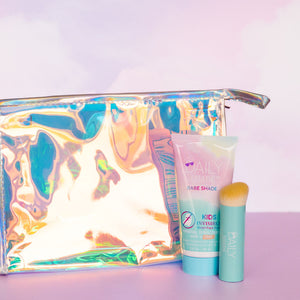
That's what Babe Shade is. No boosters. No UV chemical filters anywhere in the formula, active or inactive. Just non-nano zinc oxide at 20%, doing exactly what it was designed to do.

How to check your current sunscreen
Flip it over and look at the full ingredient list, not just the active ingredients box. Search for any of these in the inactive section: butyloctyl salicylate, ethylhexyl methoxyacrylate, tridecyl salicylate, isododecane used as a booster, or diethylhexyl syringylidene malonate. If you see them, the sunscreen is a hybrid, regardless of what the front of the bottle says.
A true non-nano zinc sunscreen won't have them. The formula will stand on zinc alone.
That surgeon at Harvard planted a seed I didn't know what to do with for years. My daughter's reaction finally made me do something about it. I'm glad she didn't have to go through that for nothing.
FAQ
What is a UV chemical booster in sunscreen? A uv chemical booster is an inactive ingredient that enhances SPF performance or stabilizes UV filters without being classified as an active ingredient. Chemically, they're nearly identical to UV filters, but the FDA doesn't regulate them the same way, so they can appear in "mineral" formulas without being disclosed on the active ingredients label.
What does non-nano zinc oxide mean? Non-nano means the zinc oxide particles are large enough that they don't absorb through the skin into the bloodstream. They sit on the skin's surface and physically deflect UV rays. This is the safest form of zinc oxide for daily use, especially on children.
Is a zinc-only sunscreen actually effective? Yes. Zinc oxide is the only single active ingredient that covers UVA1, UVA2, and UVB spectrum. It's photostable and starts working on contact. The challenge has always been aesthetics, not efficacy.
How do I know if my mineral sunscreen has boosters? Check the inactive ingredients for butyloctyl salicylate, ethylhexyl methoxyacrylate, tridecyl salicylate, or similar. These are the most common chemical boosters in sunscreens currently marketed as mineral.
Why did my child react to a sunscreen labeled mineral? Most likely because it contained chemical boosters or was a hybrid formula. Even sunscreens with a single mineral active can cause reactions if chemical compounds are present in the inactive ingredients.
