



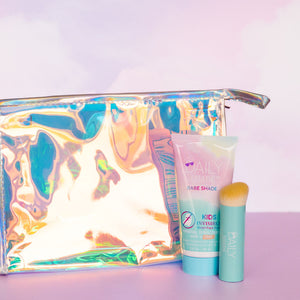




By Breelyn Vanleeuwen, PA-C | Founder & CEO, Daily Shade
When most people see “water-resistant” on a sunscreen bottle, they assume it means waterproof.It doesn’t. And what it takes to earn that claim changes how a sunscreen feels, performs, and tests in the lab.
Let’s break it down.

What Does “Water-Resistant” Actually Mean?
In the U.S., sunscreen is regulated by the FDA as an over-the-counter drug.
Brands can only claim:
-
Water resistant (40 minutes)
-
Water resistant (80 minutes)
That means:
After being submerged in moving water for either 40 or 80 minutes during controlled testing, the sunscreen must still retain its labeled SPF.
It does NOT mean:
-
Waterproof
-
Sweat-proof
-
All-day protection
-
Reapplication not needed
You still must reapply per instructions on the product every 40 or 80 minutes immediately after towel drying.
Not All Sunscreens Are Water Resistant
Here’s the part people don’t realize: Some daily sunscreens are not water resistant at all. Most people assume all sunscreens come with water resistance but this isn't the case at all. Many are designed for:
-
Office days
-
School pickup
-
Morning walks
-
Incidental sun exposure
And that’s okay if you understand when to use them. But if you’re:
-
Swimming
-
Sweating
-
At the beach
-
Playing soccer at 2 pm in Utah
Water resistance matters. Especially in high-altitude states like Utah, where UV exposure is stronger and sun intensity is amplified.

Why Water Resistance Changes the Feel of a Sunscreen
To survive water testing, formulas must include film-forming ingredients that help them adhere to the skin. That often means:
-
Slightly thicker texture
-
More grip on the skin
-
Increased durability
-
Different dry-down feel
This is why some “sport” sunscreens feel different than daily wear formulas.
It’s also why many brands rely on chemical boosters to help stabilize and enhance performance. Daily Shade does not.
Here’s Something Most Brands Won’t Tell You
When we were formulating Babe Shade, we hit SPF 50+ in lab testing. But when we added water resistance testing into the equation, our number dropped. We ultimately chose to label it SPF 30 to maintain water resistance compliance. Because we wanted:
-
Honest numbers
-
True performance
-
No hidden UV boosters artificially inflating SPF
That’s what real formulation integrity looks like.
Mineral Sunscreen + Water Resistance = Hard Mode
Formulating a true mineral sunscreen (100% non-nano zinc oxide) that is:
-
Booster-free
-
Free from 1,700 EU-banned ingredients
-
Beautiful on the skin
-
And water resistant
Is extremely difficult. Most brands solve this by adding:
-
Butyloctyl salicylate
-
Ethylhexyl methoxycrylene
-
Other chemical UV boosters
These ingredients improve spreadability and lab results. But they blur the line between mineral and chemical sunscreen. Daily Shade chose the harder path.

What About Reef Safety?
“Reef safe” is not a regulated term in the United States. But generally, formulas free from oxybenzone and octinoxate are considered reef compliant in places like Hawaii. Zinc oxide, especially non-nano zinc, is widely regarded as safer for marine ecosystems. That’s one of the reasons we use it exclusively.
How to Choose the Right Sunscreen for the Right Day
Daily incidental exposure?
SPF 30 mineral is more than adequate when applied properly.
Water, sweat, sports, beach days?
Choose water-resistant formulas and follow the directions for when you should reapply either every 40 or 80 minutes if swimming/sweating.
High UV index days?
Use hats. Seek shade. Reapply diligently.
Sunscreen is one layer of protection, not the only one.
The Bigger Conversation
Water resistance is not just a marketing label. It’s a performance standard. It changes how products are formulated. It changes how they feel. It changes SPF testing outcomes. And it absolutely changes how you should use them. The goal is not to chase the highest SPF number on the shelf. The goal is to:
-
Use it daily
-
Use enough
-
Reapply correctly
-
Choose ingredients you trust
Because up to 80% of lifetime sun damage happens before age 18. And those skin cells remember.
